
Your feed isn’t just a collection of property photos. Every real estate post you share tells people how well you know your market, how much care you put into your work, and whether you’re the agent they’d trust with their biggest decision.
This guide is all about the posts themselves: what to share each month, dozens of post ideas, how to write captions that start conversations, and how to keep it all going without burning out.
Still deciding which platforms to use or how to set up your profiles? Start with our real estate social media marketing guide, then come back here to plan your content.
What Makes a Real Estate Post Work
A good post doesn’t always lead to an instant inquiry. Often it earns a save, a share, or a place in someone’s memory when a friend mentions they’re thinking of selling. That’s still a win.
The real estate posts that perform best share three traits:
- A specific insight: “Inventory in Riverside dropped this quarter” beats “It’s a great time to buy.”
- A clear takeaway: The reader learns something they can use or remember.
- An easy next step: A question to answer in the comments, a reason to DM you, or a guide to download.
Over time, posts like these do three jobs at once: they establish you as the local expert, keep you visible during the long months before someone moves, and give past clients something to share when friends ask for an agent recommendation.

Your Monthly Content Mix
At 3–4 posts a week, you’ll share about 14 posts a month. Most agents only post reactively, sharing a listing when one comes up and celebrating when a deal closes. That leaves long, silent gaps. A planned mix keeps you visible every week, even when you have no news.
| Content type | Goal | Who it reaches |
|---|---|---|
| Market insight | Authority | Serious buyers and sellers |
| Education | Trust | First-time buyers, researchers |
| Local life | Local expertise | People considering your area |
| Personal brand | Relationship | Past clients, referral sources |
| Listings and results | Leads | Active buyers and sellers |
The 70/30 rule
Aim for roughly 70% value-driven posts and 30% direct promotion. In a 14-post month, that’s about 10 posts that help and 4 that ask for business, such as listings, testimonials and “let’s talk” posts.
This can feel like you’re not promoting yourself enough. But teaching someone how to prepare their home for sale is promotion. It’s promotion through expertise, and it earns you the right to ask.
Start with fixed dates
When you plan your month, block out the predictable posts first: your monthly market update, regular open houses, seasonal moments. Then fill the gaps with education and local content that doesn’t depend on timing. A real estate content calendar makes this much easier to keep up.
| Content Type | Frequency | Primary Goal | Audience |
|---|---|---|---|
| Market data | 1-2/month | Authority | Serious buyers/sellers |
| Educational | 2-3/month | Trust building | First-timers, researchers |
| Neighborhood | 2-3/month | Local expertise | Area-specific prospects |
| Listings | As available | Lead generation | Active shoppers |
| Personal brand | 1-2/month | Relationship | Referral sources |
30 Real Estate Post Ideas
Never stare at a blank screen again. Here are 30 ideas, grouped by content type, to fill your calendar.
Market insight
- Three numbers that tell you everything about [your area] this month.
- Rates just moved. Here’s what it actually costs you per month.
- Same month, one year apart. The difference surprised even me.
- In one neighborhood homes sell in a week. In another, it takes three months.
- Everyone’s asking if it’s a buyer’s market. The answer depends on your street.
- You’ve heard prices are dropping everywhere. Not here.
Education
- Buying a house is five steps. Most people panic at step three.
- Your offer got accepted. Here’s why you shouldn’t celebrate yet.
- Don’t repaint that bedroom. Do fix that doorknob.
- Cozy’ means small. Here’s what the rest of the listing is really saying.
- The questions first-time buyers are too embarrassed to ask me.
- Your inspector won’t check the roof. Here’s what else they skip.
Local life
- A local café, shop or restaurant you love
- A neighborhood guide in one carousel
- Weekend events roundup
- “Living in [neighborhood]: what it’s really like”
- A local business owner Q&A
- Best parks, trails or views in your area
Personal brand
- I was a terrible house hunter. That’s why I became an agent.
- Most of my job happens after 6pm. Here’s a real day.
- I’ll tell you not to buy a house. Here’s why that’s part of the job.
- The deal almost fell apart at the closing table. Here’s what saved it.
- What it takes to make a living room look this good in photos.
- The part of this job nobody sees, and the reason I love it.
Listings and results
- Just listed, with one standout detail in the first line
- Open house: Come for the sunset from the back deck. We’re open till 6:30 for a reason.
- Just sold: Seven offers, and the highest one didn’t win.
- Testimonial: She talked us out of a house we loved, and she was right.
- Before-and-after staging: Same room. $1,200 later. Under contract in 3 days.
- Coming soon: Guess the neighborhood from this doorknob.

Writing Captions That Work
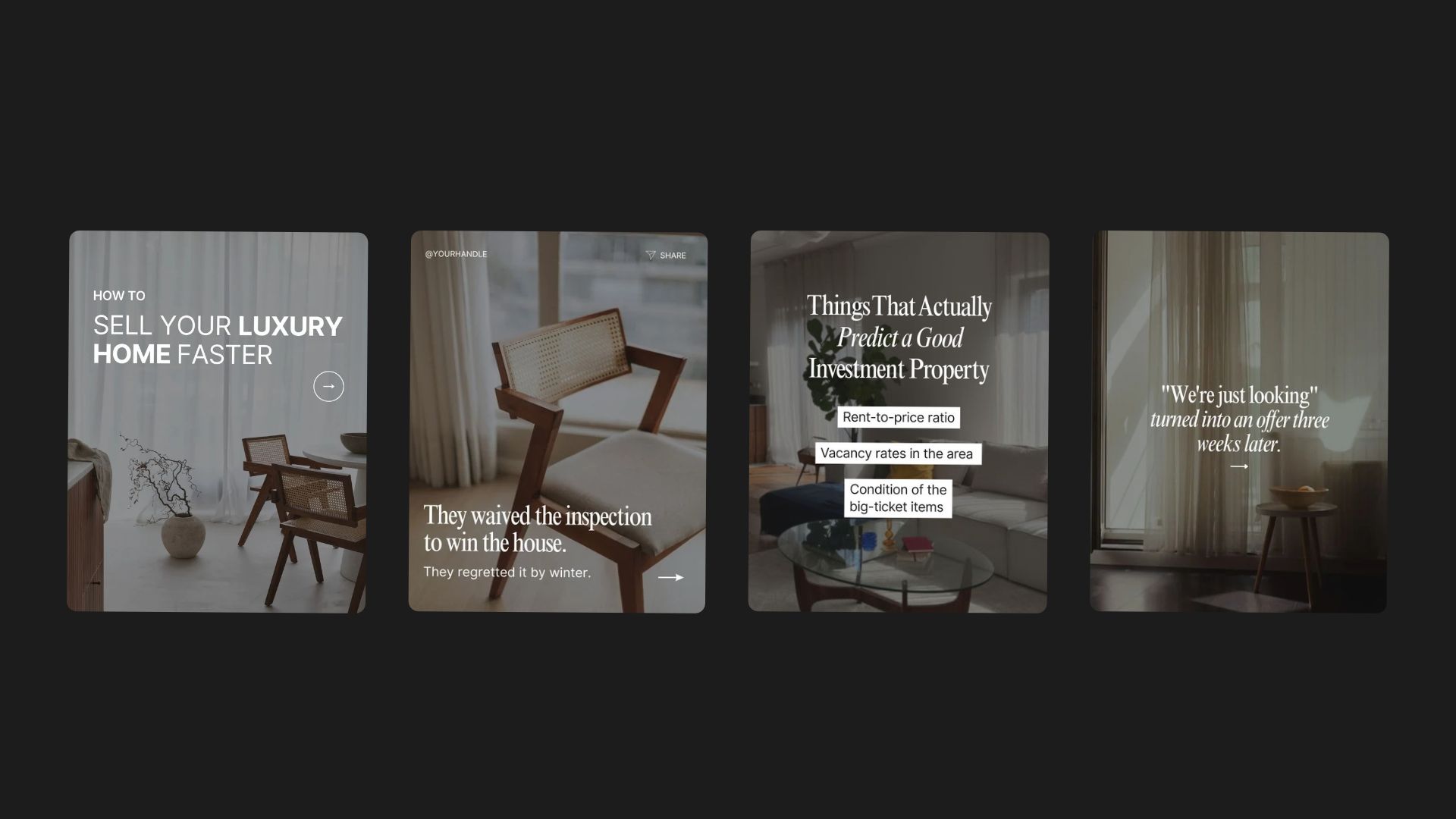
Your visual stops the scroll. Your caption decides what happens next. Skip the hard sell and build each caption around one idea that shows what you know.
A weak caption:
Just listed! Beautiful 4bd/3ba home in Riverside. DM for details!
A stronger caption:
Riverside inventory dropped this quarter, and this is one of only three move-in-ready homes to hit the market this month. Here’s what buyers need to know about competing when supply is tight. [Then the listing details, then the call to action.]
The difference is context. The second version shows you understand the market and gives even people who aren’t shopping a reason to read. When creating educational content for local search visibility, your posts should also answer the specific questions your target clients are searching for. This dual-purpose approach serves both your social audience and your SEO strategy.
A simple caption formula
- Hook: one line that names a place, a number or a surprising fact
- Insight: two or three lines explaining what it means
- Takeaway: what the reader should do or remember
- Next step: a question, an invitation to DM, or a link in your bio
Add your location and niche naturally in the caption, since many platforms use caption text for search. A few relevant local hashtags help too.
Using Templates Without Losing Authenticity
Templates give you polished design and structure, so you can spend your time on what only you can add: local knowledge and your point of view. When you adapt a template, change at least three things:
- Local data. Replace generic statistics with your market’s numbers.
- Specific examples. Name real streets, schools and neighborhoods your audience knows.
- Your perspective. Add a sentence on how you read the trend.
A template that says “Spring is a great time to sell” becomes far more useful when you add how homes in your area actually performed last spring and what that means for sellers deciding now.
Keep your posts recognizably yours
Your posts should look like they come from the same brand, even when the topics change. Use consistent colors, fonts, logo placement and photo style. Someone who sees three of your posts in two weeks should recognize all three as yours before reading your name.
Saving your brand colors and fonts in Canva means every post starts from the same branded foundation. Our tutorial on organizing your Canva folders shows you how to keep it all easy to find. For the bigger picture, see personal branding for real estate agents.
Adapting One Post for Each Platform
You don’t need new ideas for every platform. You need to reshape one idea for each. Here’s how a single monthly market update can work across the platforms you’ve chosen:
| Platform | Format | How to frame it |
|---|---|---|
| Carousel or 30–45 second reel | Three key stats, one slide each, and what they mean | |
| Post with a graphic | Local context plus a question to start conversation | |
| Short article or text post | Data-led analysis and a professional perspective | |
| Email newsletter | Feature story | The full update, plus one insight you only share with subscribers |
| Tall graphic linking to your blog | A searchable title such as “[Area] housing market update” |
The content overlaps, but the framing shifts. Not sure which platforms to focus on? Our real estate social media marketing guide walks you through choosing.
Which Posts Are Working?
At the end of each month, look at your posts by content type rather than one by one. Ask three questions:
- Which content types earn the most saves and shares? Make more of those.
- Which posts led to DMs or profile visits? Those topics are closest to your next client.
- Which posts fell flat? Try a new format or hook before you drop the topic.
For the bigger picture, including which metrics to track and how to review your overall strategy, see the tracking section of our real estate social media marketing guide.
Real Estate Posts FAQs
What should I post as a real estate agent?
Mix market insight, education, local life, personal brand and listings. Aim for about 70% helpful content and 30% promotion.
How many listing posts should I share?
About three or four a month at a 3–4 posts a week rhythm. Give each one context, such as what makes the home stand out in today’s market.
What makes a good real estate caption?
A hook with a specific detail, a short insight, a clear takeaway and an easy next step, such as a question or an invitation to message you.
Can I use templates for my real estate posts?
Yes. Templates save time and keep your design consistent. Just add your own local data, examples and opinion so each post sounds like you.
Can I post another agent’s listing?
Only with permission and in line with your MLS rules. Always credit the listing agent and photographer.
Following Industry Best Practices and Standards
Staying current with NAR’s guidance for REALTORS® ensures your content reflects current best practices and maintains professional standards. The association provides regular updates on content creation, compliance requirements, and marketing approaches that protect both agents and consumers.
Similarly, understanding technical SEO fundamentals helps when your social content drives traffic to your website or blog. The skills that make real estate posts successful on social platforms also apply when creating website content that ranks in local search results.
Your content exists within a larger ecosystem of real estate marketing, compliance, and professional standards. The most successful agents view their posts not as isolated social media activities but as one element of a comprehensive marketing approach that builds authority, generates leads, and creates lasting client relationships.

Never Plan a Month of Posts from Scratch Again
In Stately Members Club, your monthly content calendar is done for you: ready-to-use real estate post templates for every content type, captions and prompts you can adapt with your local details, reel ideas, and a luxury content pillar for agents working in the high end. Everything is designed to match, so your feed looks polished and unmistakably yours.


